

Truth or Applause
Most executive coaching sells comfort dressed as clarity—this is about stripping away approval, exposing what runs you, and leading from truth that actually holds under pressure.

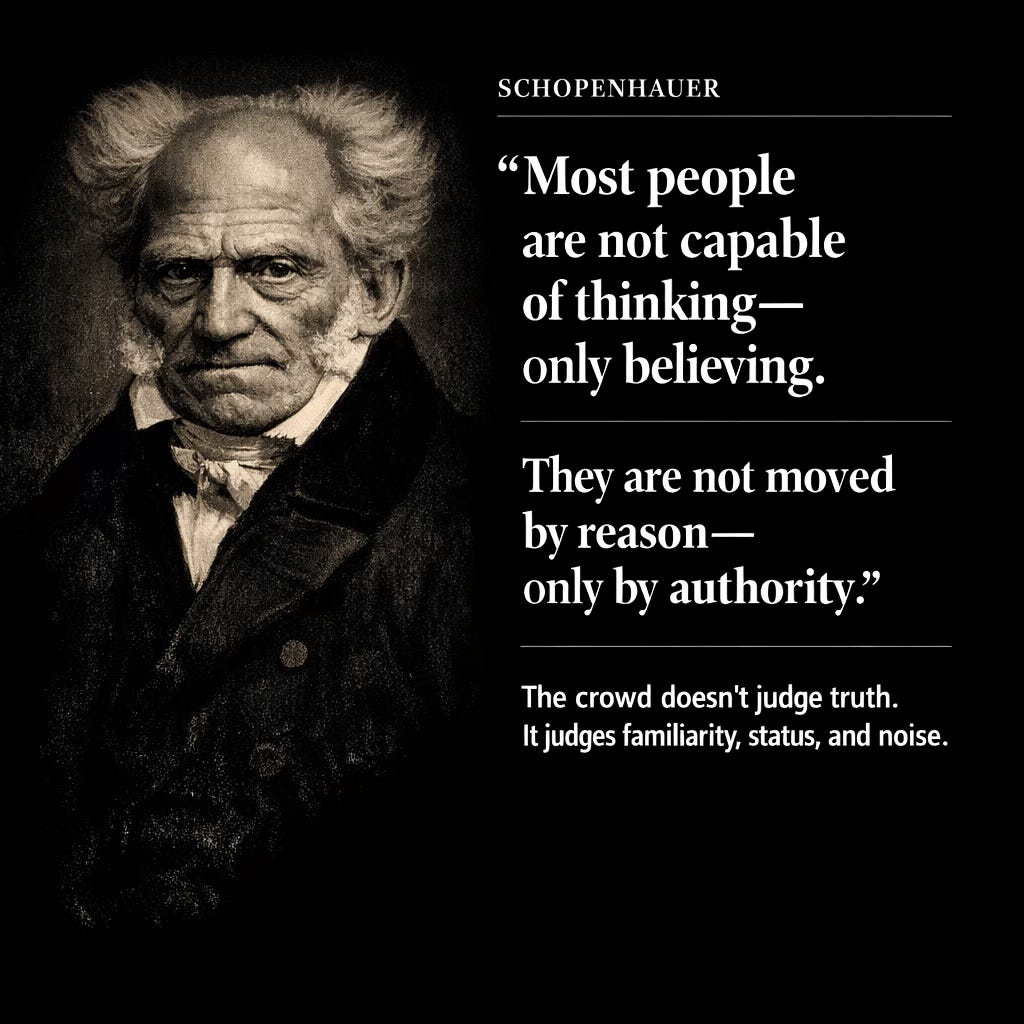
Coaching for Approval
Most coaching today is a fine piece of packaging.
Polished frameworks.
Neat models.
Three steps to clarity, five habits to greatness, and a worksheet for your conscience.
It’s all very respectable.
And it works—
if what you want is approval.
Because approval is easy to manufacture.
You just tell a man what he already believes, dress it up in better language, and charge him for the echo.
Truth is a different business.
Truth doesn’t come in frameworks.
It doesn’t follow slides.
And it rarely leaves a man comfortable enough to recommend you to his friends.
That’s why most coaching avoids it.
A one-size-fits-all program has one great advantage—
it fits no one deeply enough to offend them.
No friction.
No exposure.
No risk of touching the thing that actually runs the show.
So the executive walks away improved—
but unchanged where it matters.
Now here’s the trouble.
A leader doesn’t fail for lack of information.
He fails because he cannot see what he is unwilling to see.
And no template in the world can do that for him.
That requires something far less convenient—
a conversation that is alive, unscripted, and a little dangerous.
This is where Anthony Nayagan works.
Not with programs.
Not with packaged wisdom.
But with the man himself.
He works at three levels at once—
the inner engine (what drives you),
the personal layer (how you carry it),
and the visible execution (what the world sees).
No templates.
No borrowed language.
No polite blindness.
Just a clear look at power, fear, faith, money, and consequence—
in one room, without jargon, without ceremony.
His clients are not monks.
They are busy, burdened, ambitious people—
living in the real world, not escaping it.
And that is precisely why the work holds.
Because it is built around them—
not around a system that needs to be sold to the next client.
Most coaching asks:
“How do we improve this leader?”
Anthony asks a harder question:
“What is this leader avoiding that runs everything?”
One question produces progress.
The other produces clarity.
And clarity, once seen, has a habit of rearranging everything.
So the real question stands—
Do you want truth… or approval?
One will make you comfortable.
The other will make you dangerous.
Choose carefully.