

The Intelligence That Sees Before Thought
A deeper form of insightfulness that detects truth early, guides clean decisions, and stays steady when pressure rises.

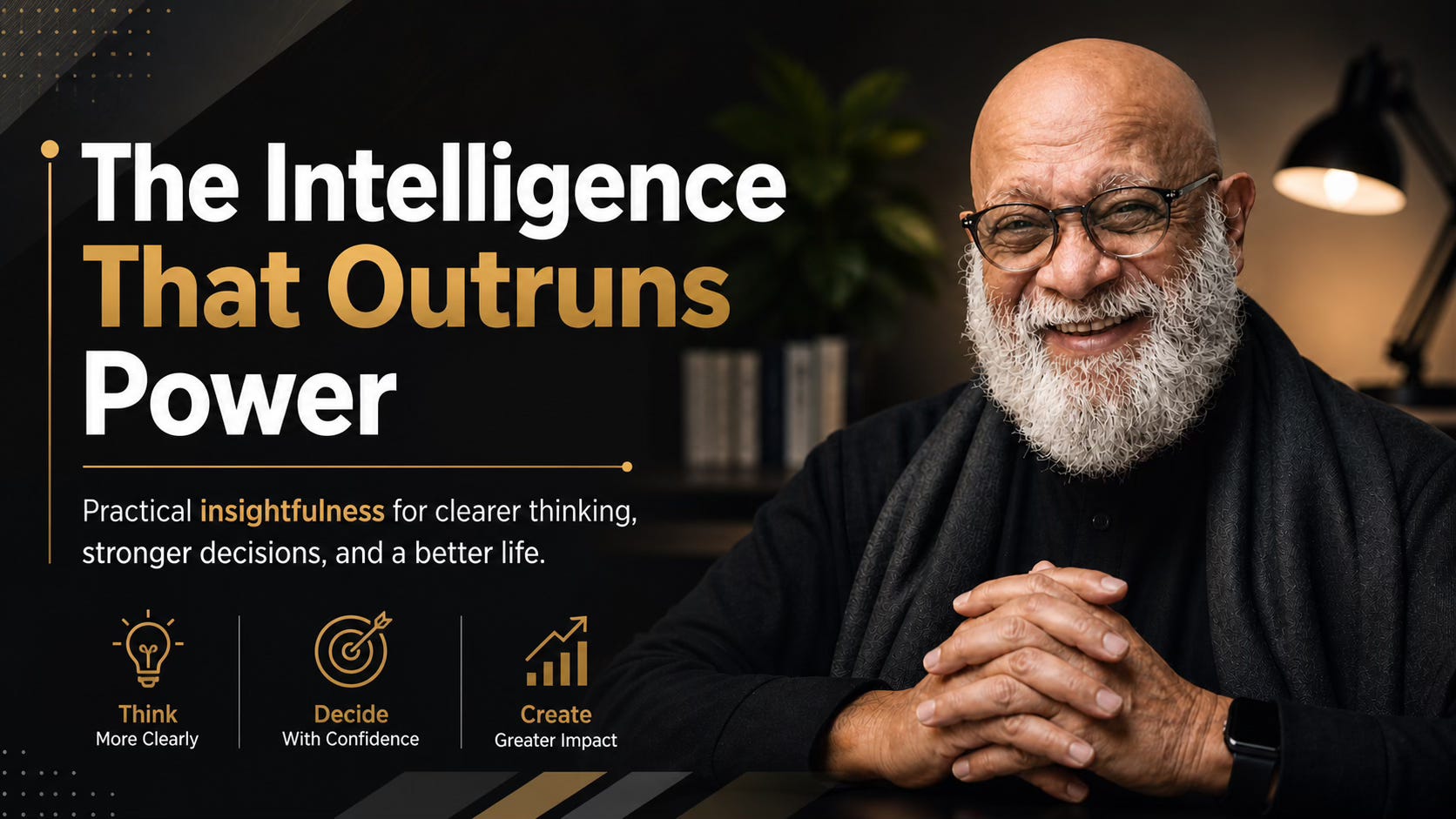
We live in an age that worships information but often remains starved of wisdom. We have access to more data than any generation in human history, yet confusion, instability, and inner fragmentation remain everywhere. The reason is simple: external intelligence alone is not enough. There is another kind of intelligence — older, deeper, quieter, and far more decisive. I call it Internal Intelligence. In the deeper spiritual vocabulary of my own tradition, I would call it Siddhic intelligence.
This is not a theory I read in a book and then repeated for effect. It is something I have seen, experienced, and lived under. It has shaped my understanding of truth, leadership, spiritual maturity, and the hidden architecture of human consciousness. It also came to me through one of the most influential figures in my life: my Guru in India.
Beyond Study and Reasoning
Siddhic intelligence does not arise from study alone, nor is it born merely from the power of reasoning. Study can sharpen the mind. Reasoning can discipline thought. Scholarship can provide vocabulary. But none of these are the source.
Siddhic intelligence is deeper than the architecture of thought.
It is the inward faculty by which truth is apprehended before it is fully spoken, named, or explained.
This kind of intelligence is not merely analytical. It is perceptive. It sees before it can articulate. It knows before it can defend itself. It recognizes reality in its essence rather than only in its outer form. For this reason, it cannot be reduced to academic achievement or intellectual performance. It is not manufactured by information.
It is awakened by grace, discipline, inward purity, and direct experience.
Many people believe intelligence is proven by the ability to explain everything. But the highest intelligence often begins where explanation ends. There are truths that cannot be forced into argument. They are encountered inwardly. They are recognized spiritually. They are known from within.
The Tradition That Still Lives in India
What I speak of is not imaginary. It is not poetry detached from reality. In India, this tradition still prevails in living form. There are still men and women who carry knowledge beyond textbooks, beyond formal education, beyond the mechanisms of modern credentialing. There are still Gurus, saints, Siddhars, yogis, and inwardly awakened beings who embody a kind of knowing that cannot be easily explained by conventional systems.
In the old spiritual culture of India, intelligence was never defined only by literacy or examination. It was also measured by realization. A person could know many scriptures and still remain inwardly blind. Another person could speak less, possess less, and yet carry a luminous discernment that penetrated deeply into life. That is because spiritual intelligence was understood as a state of being, not merely a function of mental storage.
This is why the Guru-disciple relationship mattered so profoundly. It was not merely educational. It was transformational. The Guru did not only transfer information. He transmitted consciousness. He did not merely answer questions. He shaped the seeker’s inner capacity to receive truth. This is what modern minds often miss. The Guru was never simply an instructor. He was a revealer, a purifier, and a mirror of a higher order of life.
My Own Experience With My Guru
I speak of this with personal conviction because I have lived under its influence.
My Guru in India was a living revelation of this higher intelligence. He possessed little formal education, and yet he carried himself with a depth of knowing that could not be produced by books. He seemed to know without effort, without dependence, without reference to the structures of academic learning. He never needed to advertise his knowledge, because his presence itself carried authority.
At times I would approach him with questions, expecting direct answers, and he would respond in ways that challenged my expectations. Often he would say, “What do I know? Why are you asking me all these things?” On the surface, this could sound like refusal or indifference. But in truth, there was always a hidden tenderness in him. His words were often a spiritual discipline, not a dismissal. He was not feeding my ego with immediate confirmation. He was training something deeper in me.
My ego, of course, struggled with this.
I wanted clarity on my own terms. I wanted recognition. I wanted the comfort of being told that my questions were intelligent and my concerns important. But my Guru did not always indulge that desire. Sometimes he would withhold the answer from me, only for a stranger to appear moments later and receive the very explanation I had wanted, in full and exacting detail.
This was difficult for me. It wounded my pride. It confronted my need to be seen. But later I understood that this was part of the training. He was not merely giving me information. He was breaking my dependence on external validation. He was dismantling the ego’s hunger for control and teaching me to hunger instead for truth itself.
That is the way of real spiritual instruction. It does not merely gratify the student. It purifies the student.
What My Guru Was Really Teaching Me
As I entered the labor of writing and reflecting more deeply, I began to understand that my Guru had been shaping me toward something greater than intellectual competence. He was not only teaching me facts. He was training me to receive inward sight.
He was showing me that Siddhic intelligence is not something one boasts about. It is not an achievement to parade before others. It is a gift to be received with humility. It is not the triumph of the clever. It is the awakening of the inwardly receptive.
I came to realize that much of what I later wrote — across theology, physics, cosmology, philosophy, life science, and psychology — did not originate first as external study. Before the books, before the terminology, before the categories were mentally arranged, there was already an inward impression. The truth arrived first as pattern, presence, and possibility. The mind later caught up and gave language to what had already been inwardly received.
This is why I can no longer think of wisdom as merely the result of education. Education matters. Study matters. But they are not the source. The source is higher. The source is deeper. The source is the awakening of a faculty within the human being that sees reality from within rather than only from the outside.
External Intelligence Has Limits
Modern life has exalted external intelligence to such an extent that many people now believe if something cannot be measured, it cannot be trusted. That assumption is profoundly limited.
External intelligence gathers data. It counts, compares, ranks, and predicts. It is extremely useful. But it is still incomplete. It can tell you what happened, but not always why it happened. It can describe a pattern, but not always detect its moral or spiritual root. It can generate solutions, but not always discern whether those solutions are wise.
That is why so many high performers remain inwardly lost. They may be successful, articulate, and admired, yet still fragile, divided, and exhausted. Performance without inner order becomes theater. And theater, no matter how polished, eventually collapses under pressure.
Internal Intelligence addresses this problem at its root. It restores order within the person before demanding order from the institution. It teaches that clarity must first be inward before it can become external. A fragmented leader produces a fragmented culture. A centered leader creates space for truth, trust, and proportion.
What Internal Intelligence Looks Like in Practice
Internal Intelligence is not mysticism in the vague sense. It is practical power.
A person with Internal Intelligence can detect what others miss. They hear what is not being said. They notice hesitation in a room. They sense false agreement. They recognize when urgency is merely a mask for poor thinking.
They also remain steady under pressure. They do not fracture when the heat rises because their stability does not depend on applause, image, or control. They are anchored from within. They can respond wisely rather than react impulsively.
They use power cleanly. They do not need to dominate because they are already governing themselves. They understand the difference between authority and intimidation. One commands respect. The other merely provokes fear until it fails.
They create meaning, not just motion. They do not extract labor alone; they inspire alignment. People can work for money, but they sacrifice for meaning. Internal Intelligence helps create cultures where purpose is stronger than pressure.
This is why I say it outruns power. Because power without inward clarity eventually becomes distortion. But when power is guided by Internal Intelligence, it becomes constructive, disciplined, and trustworthy.
Why This Matters for the Modern World
We live in a time that rewards speed, visibility, and performance. But speed without clarity becomes danger. Visibility without substance becomes vanity. Performance without inward depth becomes exhaustion.
The world does not only need more ambitious leaders. It needs more discerning ones. It does not only need people who can move fast. It needs people who can see truly. The future will not belong merely to those who know more. It will belong to those who perceive more accurately.
That is why this subject matters so deeply to me. I am not speaking about an abstract spiritual principle detached from real life. I am speaking about a living intelligence that governs how we think, how we lead, how we suffer, how we discern, and how we remain steady in a world that constantly tries to fragment us.
The Awakening Is Still Possible
One of the most important truths I have come to understand is that this intelligence is not lost. It is dormant in many, but not absent. It is in the DNA of all of us to awaken to it. We have all tasted something of it before, even in the simple learning of our vernacular language. We once knew how to absorb, imitate, and embody before we could explain what we had learned. That capacity has not disappeared. It must simply be reawakened.
If you are spiritually inclined, the path may open through prayer, silence, meditation, surrender, and devotion. If you are more scientifically minded, you may begin by observing consciousness, pattern recognition, and the limits of reductionistic reasoning.
But whichever path you take, the invitation is the same . . . move from surface knowing to inward knowing, from cleverness to clarity, from information to realization.
Final Word
I do not write about my personal testimonies often, but when I do, it is because they are essential to the truth I am trying to convey. My relationship with my Guru was not merely one episode in my life. It was formative. It taught me that intelligence can be sacred, that truth can be transmitted through presence, and that the deepest education may come not from lecture, but from surrender to a higher way of seeing.
That is why I speak of Siddhic intelligence and Internal Intelligence as one continuous reality — sacred in essence, practical in expression, and transformative in every sphere of life.
We may call it wisdom. We may call it discernment. We may call it inward sight. But whatever name we use, the reality remains: there is an intelligence that outruns power, surpasses information, and sees what the mind alone cannot.
And once awakened, it changes everything.