

Innovation Without Disruption
How Organizations Can Build the Future While the Present Continues to Win. A Strategic Framework for C-Suite Leaders, Boards of Directors, and MBA Programs.

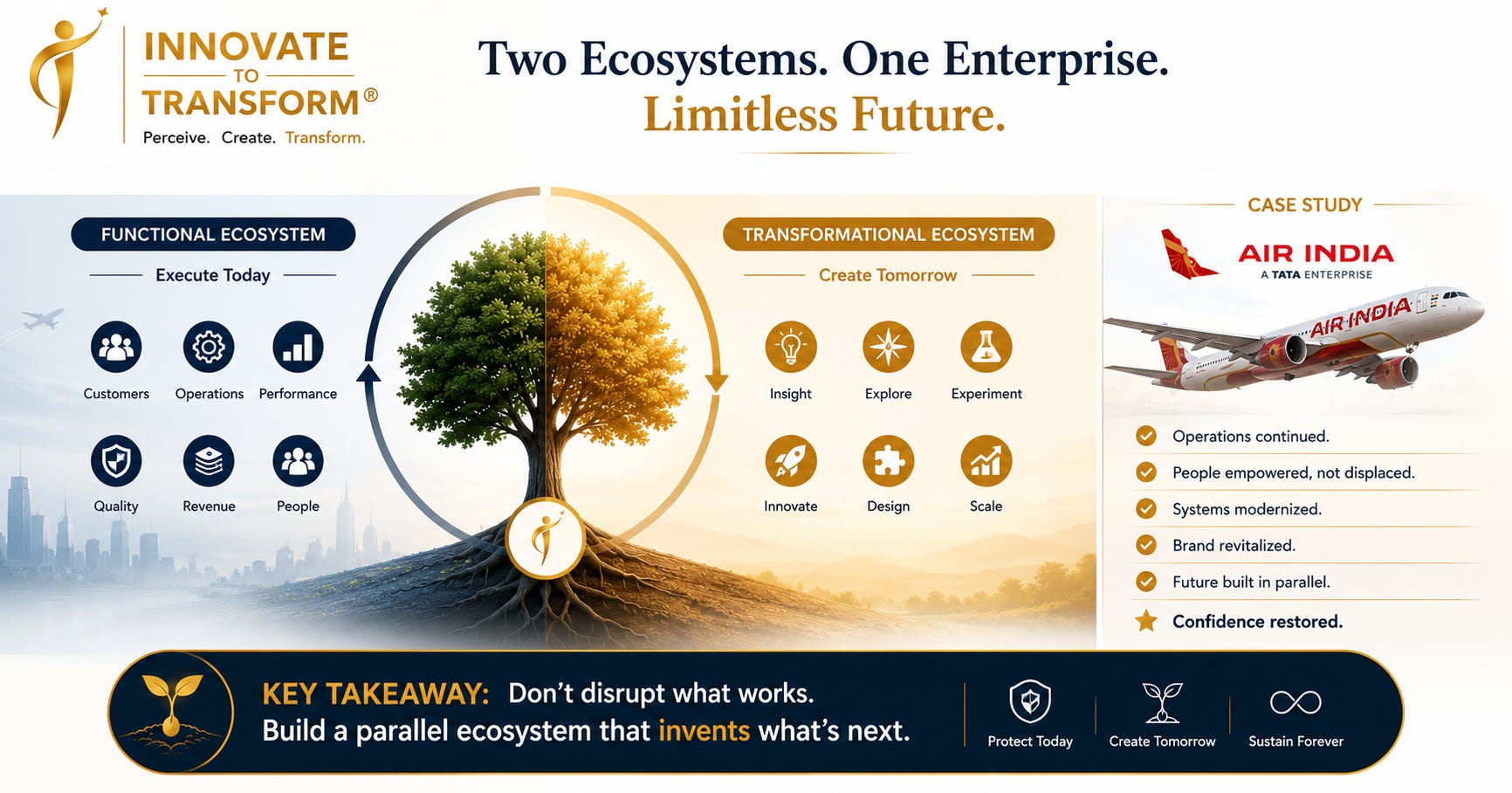
The companies that dominate the next decade will not be those that optimize the present.
They will be those that quietly build the future while the present continues to win.
Don't disrupt what works. Build what comes next.
Executive Summary
One of the greatest misconceptions in modern management is that transformation requires disruption.
Consequently, many organizations postpone transformational initiatives—not because they fail to recognize the need for change, but because they fear destabilizing the very systems that sustain their current success. Boards worry about shareholder confidence. Executives worry about execution. Employees worry about their future. Customers worry about service continuity.
These concerns are legitimate.
Yet they are based upon an outdated assumption that organizational transformation must occur by replacing the existing operating system.
This report argues the opposite.
Drawing upon the theoretical foundation presented in The Architecture of Human Intelligence, this paper proposes that sustainable transformation is achieved by establishing a parallel Transformational Ecosystem that operates alongside the existing Functional Ecosystem. Rather than dismantling operational excellence, organizations preserve and strengthen it while simultaneously creating a dedicated environment responsible for discovering future paradigms. The underlying white paper presents Innovate to Transform© as an operational framework within a broader architecture of human intelligence, not as a substitute for existing organizational systems.
The transformation of Air India under Tata Group provides a compelling contemporary example. Tata did not suspend airline operations. It did not dismantle the workforce. Instead, it invested in governance, digital infrastructure, leadership, customer experience, and organizational culture while the airline continued serving millions of passengers.
The lesson extends far beyond aviation.
Organizations that endure will not choose between operational excellence and transformational innovation.
They will institutionalize both.
The Executive Dilemma
Every executive team faces two fundamentally different responsibilities.
The first is to deliver today’s results.
The second is to invent tomorrow’s opportunities.
Unfortunately, most organizations attempt to accomplish both through the same operating system.
That creates an unavoidable conflict.
Operational systems are designed to minimize uncertainty.
Innovation depends upon exploring uncertainty.
Operations reward consistency.
Innovation rewards experimentation.
Operations standardize.
Innovation challenges standards.
Operations protect existing revenue.
Innovation questions whether today’s revenue model will remain relevant tomorrow.
When these opposing objectives are managed through one organizational architecture, each weakens the other.
Execution becomes distracted.
Innovation becomes constrained.
Transformation slows.
Eventually competitors redefine the industry while established leaders continue optimizing yesterday’s assumptions.
Why Transformation Initiatives Frequently Fail
Corporate history is filled with ambitious transformation programs.
Digital transformation.
Artificial intelligence transformation.
Business transformation.
Organizational redesign.
Culture transformation.
Despite significant investment, many fail to achieve their intended outcomes.
The reason is rarely technological.
Nor is it financial.
The deeper problem is architectural.
Organizations often attempt to redesign the system responsible for current execution while simultaneously asking it to sustain present performance.
Employees become uncertain.
Managers become conflicted.
Customers experience inconsistency.
Investors lose confidence.
Transformation becomes synonymous with instability.
Ironically, the organization attempting to become more adaptive frequently becomes less adaptive.
The difficulty is not transformation itself.
It is expecting one operating system to perform two fundamentally different missions.
A Different Architecture: Two Ecosystems, One Enterprise
Innovate to Transform© proposes an alternative organizational design.
Rather than replacing the existing operating model, organizations establish two complementary ecosystems.
1. The Functional Ecosystem
The Functional Ecosystem remains responsible for everything that creates present value.
It delivers products and services.
Maintains operational excellence.
Serves customers.
Protects regulatory compliance.
Generates revenue.
Optimizes quality.
Executes strategy.
Measures performance.
Everything that currently works continues to work.
Nothing is unnecessarily disrupted.
2. The Transformational Ecosystem
Alongside it operates a second ecosystem.
Its purpose is entirely different.
It is not responsible for quarterly execution.
Its responsibility is future discovery.
It studies changing customer behavior.
Identifies emerging technologies.
Challenges existing assumptions.
Recognizes weak signals.
Builds new business models.
Develops leadership capability.
Designs future organizational architectures.
Discovers opportunities invisible to the current operating system.
The Functional Ecosystem protects today’s business.
The Transformational Ecosystem discovers tomorrow’s business.
Neither competes with the other.
Together they form a continuously adaptive enterprise.
The Air India Transformation: Reinvention Without Organizational Shock
Few modern business stories illustrate this philosophy more clearly than Air India’s transformation under Tata Group.
When Tata regained ownership in 2022, the organization faced decades of accumulated complexity.
Legacy technology.
Fragmented systems.
Declining customer confidence.
Operational inefficiencies.
Cultural fragmentation.
Financial distress.
The obvious temptation would have been radical restructuring through organizational disruption.
Instead, Tata followed a different path.
Flights continued.
Passengers continued traveling.
Revenue continued flowing.
The airline continued operating while transformation occurred behind the scenes.
Leadership simultaneously modernized fleet strategy, rebuilt customer-facing digital platforms, established a cloud-first enterprise architecture, introduced AI-enabled customer support, renewed governance, strengthened analytics, revitalized the brand, and integrated multiple operating entities.
Most importantly, Tata did not pursue transformation primarily through large-scale workforce reductions.
The source material supporting this report describes a strategy centered on digitizing employee experiences, simplifying work processes, integrating organizational cultures, professionalizing management, and creating clearer accountability rather than relying on mass layoffs as the principal transformation mechanism. Employees were equipped with new digital platforms, integrated systems, and improved operational processes designed to enhance both execution and morale.
This distinction is strategically significant.
Organizations often mistake cost reduction for transformation.
They are not the same.
Reducing payroll improves financial statements.
Transforming organizational capability improves competitive advantage.
Tata’s emphasis was not simply on reducing organizational size.
It was on increasing organizational capacity.
That represents a fundamentally different philosophy of leadership.
Human Capital Is Not a Cost Center. It Is the Transformation Platform.
One of the greatest fears surrounding organizational transformation concerns people.
Employees naturally ask:
“Will transformation eliminate my role?”
Managers wonder whether years of accumulated expertise will suddenly become obsolete.
Boards worry that uncertainty will reduce engagement.
Investors fear organizational instability.
Innovate to Transform© approaches this challenge differently.
Transformation succeeds when people become participants rather than casualties.
The existing workforce represents accumulated organizational intelligence.
Institutional memory.
Customer relationships.
Operational judgment.
Technical expertise.
These capabilities should be expanded rather than discarded.
The Transformational Ecosystem therefore functions as a developmental environment.
Employees continue performing their current responsibilities within the Functional Ecosystem while selected leaders, teams, and future-oriented initiatives participate in the Transformational Ecosystem.
Rather than creating fear, transformation creates opportunity.
Rather than diminishing confidence, it increases confidence.
People understand that the organization is investing not only in new technologies but also in their continued relevance.
The message changes completely.
Instead of saying,
“We are replacing the old organization,”
leadership communicates,
“Together we are building the next chapter of this organization.”
That difference changes culture.
Why Confidence Increases Instead of Declines
Confidence is rarely created by promises.
Confidence emerges from visible stability.
Customers continue receiving reliable service.
Employees continue succeeding in their roles.
Investors continue observing operational discipline.
Meanwhile, future capabilities steadily emerge in the background.
Transformation becomes evolutionary instead of revolutionary.
Organizations no longer experience dramatic organizational “change events.”
They develop permanent adaptive capacity.
Employees begin viewing innovation as professional growth rather than organizational threat.
The psychological environment changes from anxiety to curiosity.
This is one of the most underestimated advantages of parallel transformation.
The Philosophy of Transcendence
Innovate to Transform© is built upon a philosophy of transcendence rather than replacement.
Modern management frequently assumes progress requires destroying what came before.
Nature demonstrates another pattern.
A child does not eliminate the adult.
The adult includes the child.
Calculus does not replace arithmetic.
It builds upon it.
Artificial intelligence does not eliminate human intelligence.
It increases the strategic importance of uniquely human perception, judgment, and discernment. The white paper argues that future competitive advantage depends increasingly on perceiving possibilities beyond existing knowledge through the integration of Inner, Perceptive, and External Intelligence.
Likewise, transformational organizations do not abandon operational excellence.
They transcend it.
The Functional Ecosystem continues creating value.
The Transformational Ecosystem continuously expands what value may become.
Transformation therefore becomes cumulative.
Not destructive.
The Seed That Becomes the Forest
Nature has already solved the organizational problem modern corporations struggle to understand.
Consider a single fruit.
It performs many functions simultaneously.
It nourishes people.
Feeds birds.
Supports ecological systems.
Protects the seed.
Only after fulfilling those purposes does the seed begin another journey.
Quietly.
Patiently.
Without disturbing the fruit’s existing purpose.
Eventually the seed becomes a tree.
Years later, that tree becomes an entire forest.
The fruit never competes with the seed.
The seed never criticizes the fruit.
Each fulfills a different purpose within the same living system.
Organizations evolve in precisely the same manner.
Today’s business is the fruit.
It serves customers.
Generates cash flow.
Supports employees.
Rewards shareholders.
Within that healthy enterprise another possibility quietly develops.
That possibility is the Transformational Ecosystem.
It is not designed to compete with current operations.
It exists because every successful organization eventually reaches the limits of its existing assumptions.
The future therefore grows inside the present long before the market recognizes it.
That is transcendence.
Leadership Implications
The coming decades will not be defined merely by artificial intelligence.
Nor by digital transformation.
Nor by automation.
They will be defined by organizations capable of institutionalizing perception.
Operational excellence will remain essential.
But it will no longer be sufficient.
Leadership must therefore become architecturally dual.
One responsibility protects the present.
The other discovers the future.
One measures execution.
The other measures emerging possibility.
One produces today’s performance.
The other ensures tomorrow’s relevance.
Organizations that master this balance will continuously renew themselves without repeatedly destabilizing themselves.
Implications for MBA Education
Business education has historically focused on managing existing enterprises.
Finance.
Operations.
Marketing.
Strategy.
Economics.
Analytics.
These disciplines remain indispensable.
Yet future executives must master another capability.
The ability to design organizations that continually generate transformation without sacrificing operational excellence.
Tomorrow’s competitive advantage will belong not simply to organizations that know more.
Artificial intelligence increasingly democratizes knowledge.
Competitive advantage will belong to organizations that perceive sooner.
That shift requires a new generation of leaders capable of designing cognitive ecosystems rather than merely organizational structures.
MBA education therefore stands at an important crossroads.
The future executive must learn not merely how organizations perform.
The future executive must understand how organizations evolve.
Conclusion
The greatest strategic mistake organizations make is believing transformation begins when the existing organization changes.
Transformation begins much earlier.
It begins the moment leadership establishes a protected environment where tomorrow can quietly emerge while today continues succeeding.
This is precisely what nature has always done.
Every forest once existed as a seed hidden inside a fruit.
The fruit continued nourishing life.
The seed quietly prepared the future.
Neither disrupted the other.
Together they sustained the continuity of life.
Organizations should evolve in exactly the same manner.
Innovate to Transform© is therefore not a methodology for disrupting successful organizations.
It is an architecture for ensuring they remain successful long after today’s competitive advantages have become tomorrow’s history.
The companies that will lead the next generation of industry will not be those that merely optimize what already exists.
They will be those that possess the discipline to build a second operating ecosystem—one that continually discovers what the organization must become while preserving everything that made it successful in the first place.
“Anthony has grown there into a strategic idol and a transformational authority à la Tony Robbins in his very best heyday.”
— Antonius Bakker, Writer, Speaker & Executive Coach, Netherlands
https://lekh.co/innovate-to-transform-why-its-time-to-take-marketing-back-to-the-drawing-board/
About Anthony Nayagan
Anthony Nayagan is an executive coach, keynote speaker, and creator of Innovate to Transform©—a leadership framework that helps executives move beyond optimization to fundamental transformation. His work enables C-suite leaders, entrepreneurs, and policymakers to recognize opportunities others overlook, access deeper sources of insight, and redesign organizations for the emerging industrial order rather than merely improving yesterday’s models.
Drawing from leadership, systems thinking, philosophy, human behavior, and contemplative traditions, Anthony equips leaders to perceive patterns before they become obvious, make better decisions under uncertainty, and build organizations capable of shaping markets instead of reacting to them.
He works with organizations through executive coaching, strategic advisory, leadership immersions, and keynote presentations.
For coaching or speaking engagements, contact:
Rohit Soni
rohitsonibiz@gmail.com
📞 +91 94661 94492